God of the Underworld
My second adventure with Expedition X took me somewhere that still feels slightly unreal when I say it out loud: Slovenia, with its emerald forests, limestone ridges, and that particular hush you only get in karst country, where the earth is always hinting at hidden rooms beneath your feet.

The team destination was the primaeval corridor of the Postojna Cave system and, perched above it like a stone talon, Predjama Castle. If you have never seen Predjama in person, it is difficult to convey the shock of it. The fortress is not merely built on a cliff. It is fused into the mouth of a cavern, an architectural graft on living rock, with darkness breathing behind the walls. Even before you get to any ghost stories, the place already feels like a threshold.
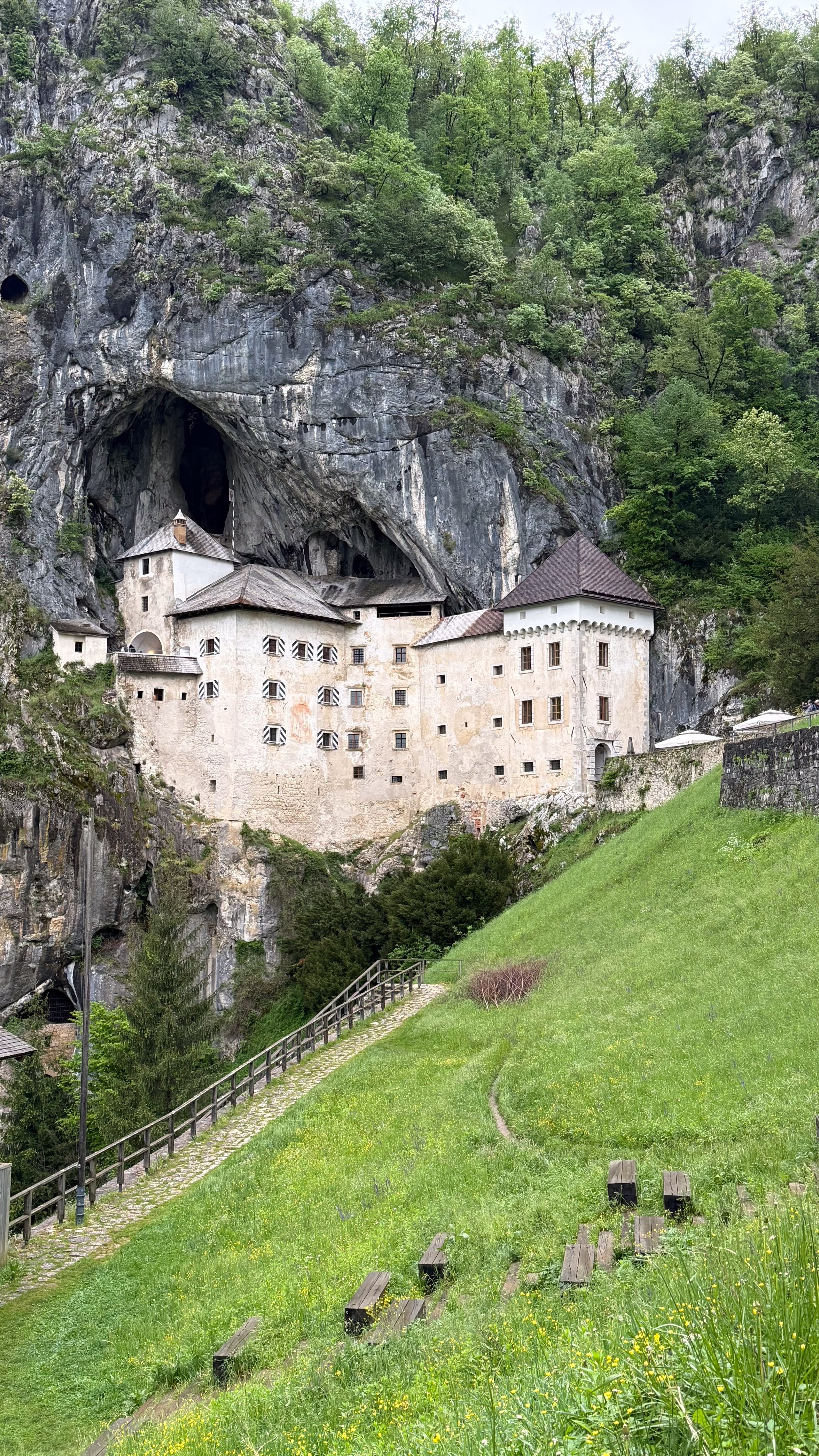
As always, the episode had its own arc, and one of the central narratives was the long shadow of Erasmus of Lueg, the famous 15th-century “robber baron” said to have used the castle’s secret passages and caves to outwit his enemies. Erasmus is the obvious anchor for a haunting story because he gives the phenomenon a human face and a neatly dated origin. A name, a motive, a death. The classic ingredients.
But standing there, in a site that is half fortress and half underworld aperture, I found myself wanting to widen the frame. Not because the Erasmus legend is uninteresting, but because some places feel older than the biographies we attach to them. They carry a density that does not behave like a single restless personality. It is more like a current.
That is where Veles came into the conversation
In Slavic mythology, Veles is often described as a chthonic god associated with the underworld, wealth, cattle, and the damp, serpentine powers that dwell below. He is a shapeshifter in many tellings, frequently associated with snakes or dragon-like forms, and he belongs to that deep Indo-European pattern in which the underworld is not simply “hell” but the realm of roots, hidden treasure, ancestral force, and the raw engine of transformation. In some traditions, he stands in tension with a sky or storm deity, a cosmic rivalry that plays out as a struggle between upper and lower worlds, thunder and coil, order and the fertile wild.
Now take that mythic logic and place it into Predjama’s geography
You have a castle literally embedded in a cave mouth, with tunnels and sinkholes knitting the site into the wider karst labyrinth. You have water moving through rock. You have the sense of a “below” that is not metaphorical, but physical, immediate, and patiently vast. In that context, the idea of the underworld is not a Halloween costume. It is the ground truth of the landscape. The caves are not just scenery. They are the governing symbol.
So my suggestion on site was simple: what if the strange activity is not only the echo of Erasmus, but also the castle’s deeper entanglement with the underworld stratum of the region itself? What if the phenomenon behaves less like an isolated haunting and more like a localised intelligence shaped by place, myth, and centuries of human projection? Veles, in that sense, is not just a “monster in the dark.” He is a name for the kind of power that caves have always represented: the hidden economy of the earth, the ancestral reservoir, the serpent-current that makes thresholds feel alive.
I always try to be careful with claims here. I am not saying, “It is definitely Veles,” as if mythology were a crime scene with a single perpetrator. What I am saying is that certain landscapes invite certain archetypes with a force that can be hard to ignore when you are actually there. Predjama is one of those places. It practically stages the underworld for you, then waits to see what you bring to it.
Slovenia gave us more than a location. It gave us a mood, a texture, a living mythos. And whether you interpret what happens at Predjama through the lens of a robber baron’s restless legend or through the older myth of Veles, the result is the same: you leave with the strong suspicion that some castles are not merely built on the land.