Francesco Dimitri’s Pan, Hypersigils, and the Return of Enchantment
It’s a strange feeling to realise that a younger version of yourself lives on in someone else’s fiction.
I’ve been friends with Francesco Dimitri for over twenty-five years, and Dagon, who appears in Pan and his other books, is based on a younger, much more reckless me. There’s a warm feeling in seeing that, but it’s also unsettling.
While I keep growing older, taking on new responsibilities and changing how I see the world, the fictional version of me stays the same for readers who never knew me. Now that Pan is about to be published in English, that younger self is about to meet a whole new group of people.
What follows contains spoilers for Pan, so you may want to read the novel first. This is more a retrospective than a review, because I have said repeatedly for nearly twenty years that it is one of the best urban fantasy novels ever written.
My purpose here is to return to a book that remains deeply personal to me, consider how its themes speak to our increasingly bleak world, and revisit the younger version of myself who still lives within its pages.
Pan was first published in Italy by Marsilio in 2008, and now, thanks to Sophia McDougall’s translation, it will reach English readers through Tor Books on 13 October 2026. Eighteen years is a long time for a person, and even more so for a magical idea. This gap raises a tougher question than whether the novel has aged well. What happens to a story about the return of enchantment when the world it enters now feels even more worn out? Looking back from its first release to today, I can’t resist wondering if Greyface, the force of repression and lifeless order that opposes Pan in the novel, has ended up winning.
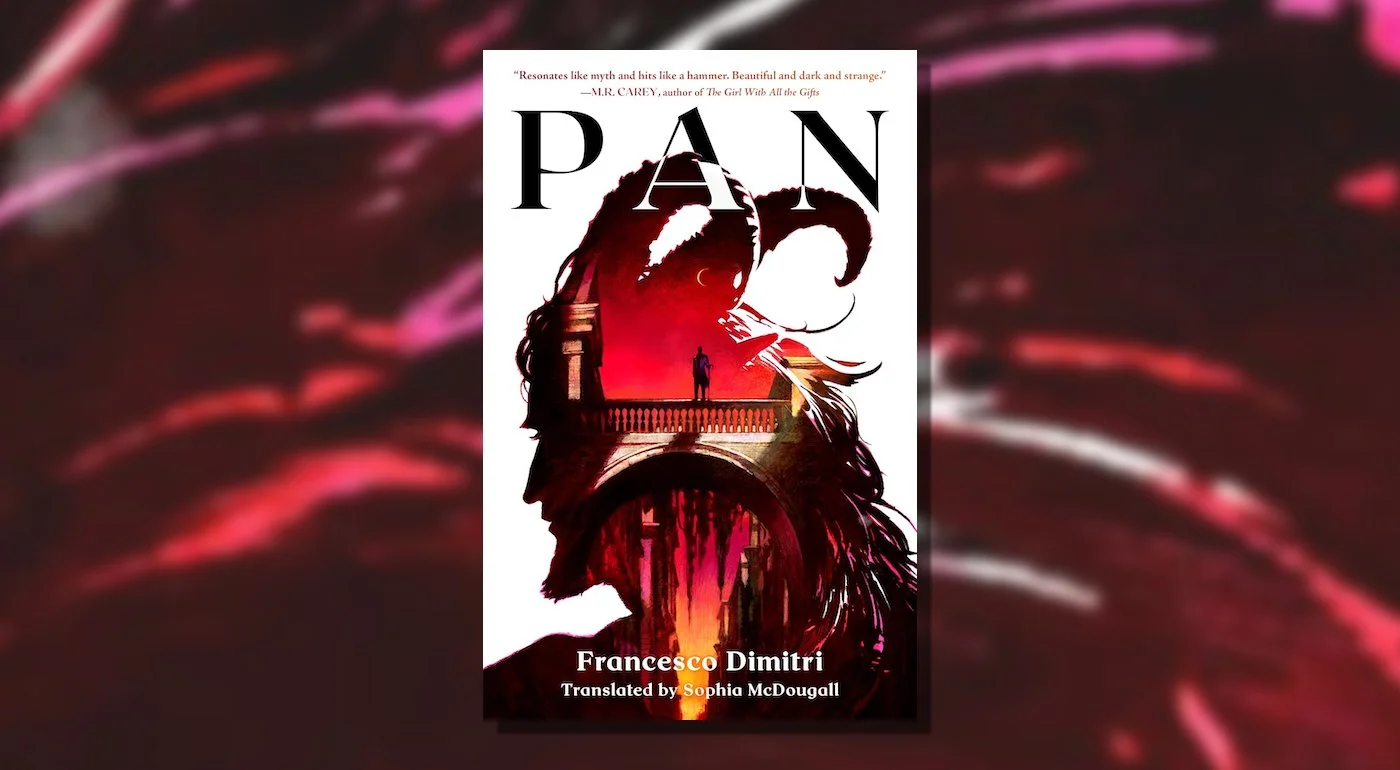
Dimitri brings the struggle from Peter Pan into modern Rome, where the old god’s return makes everyday life open to something fierce and dangerous. He uses ideas like Flesh, Enchantment, and Dream to let the city exist on different levels, with familiar streets leading to possibilities people usually ignore. What strikes me is how close those possibilities still are. Sometimes, the difference between an ordinary and an extraordinary life is simply a shift in attention, a chance meeting, or a decision you can’t take back. That idea is appealing to anyone who has ever felt that the usual paths of adulthood are too limited.
The story’s opening puts that appeal in a harsh light. Our heroine, the Wondrous Wendy, does magic tricks in Piazza Navona, dealing with customers’ egos while feeling more and more distant from the enchantment she offers. Around her, children’s dreams fill needs that real life hasn’t met, but danger finds its way into those dreams too. The mix of desire, shame, and threat gives the fantasy its power. Wonder already comes with a price, and being deprived of it makes people easy targets for promises of rescue. Reading it now, it’s hard to see 2008 as a time of promise, despite how much better those years look from our current vantage (or disadvantaged?) point. The exhaustion was there from the start, along with the urge to escape it in any way possible.
In an interview when the book first came out, Francesco said that imagination is a power that isn’t always kind, and he put the question of whether people should trust the gods at the heart of the story. That’s important if anyone wants to see the novel as a hopeful take on magick. The wild doesn’t promise to treat us well. Francesco’s version of Pan also includes sexual violence, which means we can’t simply link instinct with freedom. A force that breaks boundaries might also harm something fragile. The book’s sense of danger is part of what makes its invitation feel serious.
For me, Dagon's presence as one of the novel’s key characters makes that invitation personal. Readers of La Ragazza dei Miei Sogni, Dimitri’s debut novel, will already know him as a magician and an industrial musician, moving between endless club nights made of music and sex and the supernatural (or should we say, supra-rational?) world. Those realities were close enough together in my own life for Francesco to make something recognisable from them. The connection even took a physical turn when La Ragazza dei Miei Sogni became a movie, and I helped renowned Italian actor Nicolas Vaporidis with DJing and advice on magical techniques, definitely one of the oddest and most surprising experiences I lived through. Something of my life had entered fiction, and I was helping it return to a body. A recurring character acquires an independence that neither the author nor the person behind him can entirely govern.
That’s one reason I’ve always seen Pan as a hypersigil.
In Grant Morrison’s magical terms, a hypersigil is an intention carried through a work that evolves over time. While a regular sigil packs desire within a symbol, a story can give it characters, situations, feelings, and time. Morrison explored this idea in The Invisibles, treating the link between fiction and real life as something a magician could entangle so the work becomes a space where a possible reality is imagined, lived in, and connected to life outside the story.
Back in 2009, Francesco talked about storytelling as the way to rewrite the world, but he always said the story itself had to come first. That balance is fundamental, and I see Pan’s magical aim as encouraging readers to challenge a limited view of reality and to be more open to something beyond it. The novel makes that possibility feel real while you read; calling it a hypersigil means we have to ask if the experience keeps working after the book is finished.
Dagon clearly embodies the path between fiction and real life, when part of my own story went into Francesco’s book, and now that story comes back to me, making me think about who I’ve become. It can also reach people who don’t know either of us, and, as a magician, I accept that these connections can go beyond what we can easily explain. Still, their everyday effects are real. An image can make someone want to try something new, a character can spur action, and a story can help people see each other. The magical idea starts to feel real when such instances actually change what people do.
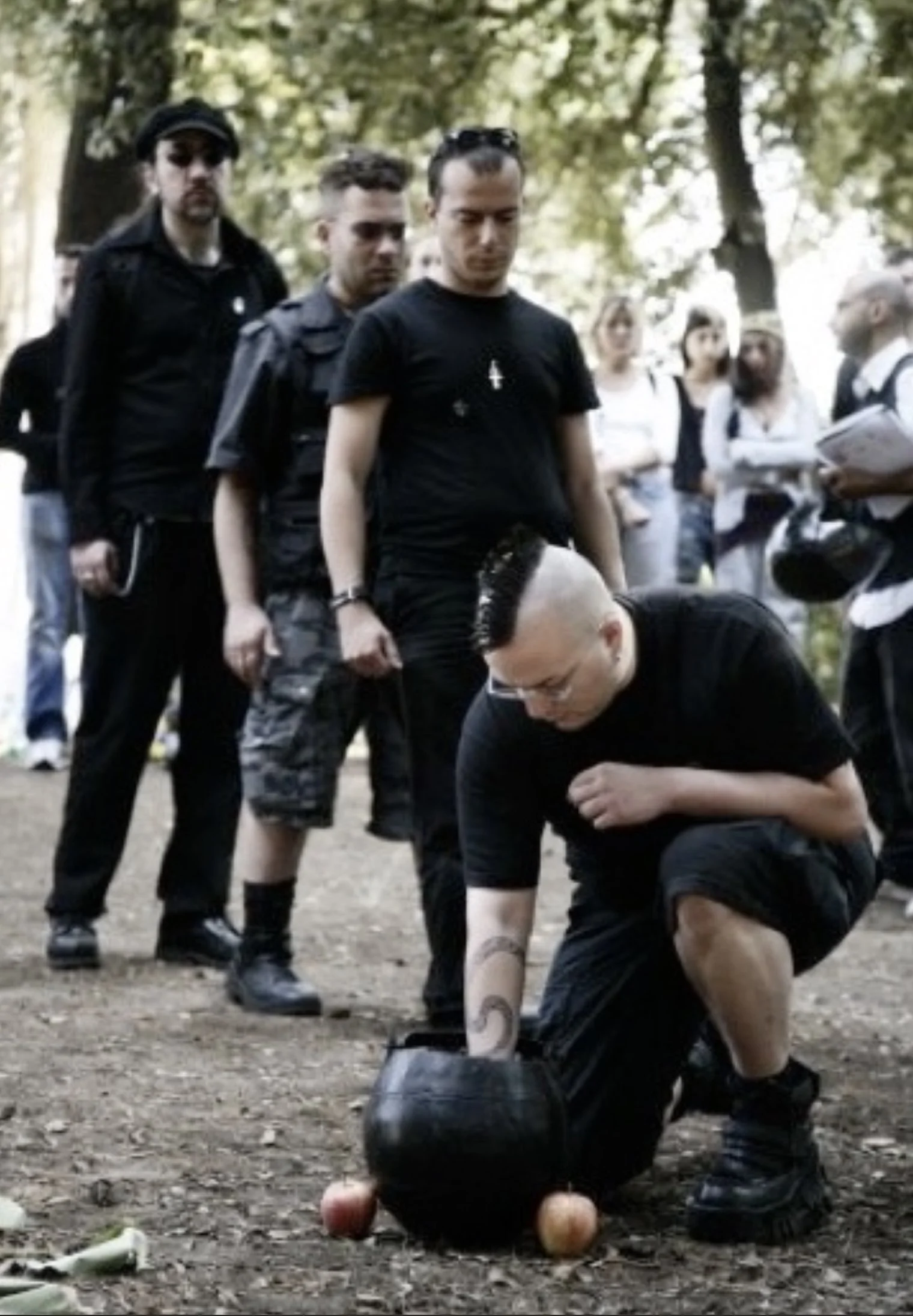
Italian Pagan Pride, Rome, 2008.
Me, kneeling, with Francesco right behind me.
Eighteen years later, I see the recklessness in my younger self as more complicated than I once did. There’s bravery in rejecting the life you’re given, but it’s also easy to think that passion excuses everything. Now, I have to figure out what’s worth keeping and what was just youthful desire dressed up as something bigger. I still want to hold on to the refusal to settle, the curiosity, and the willingness to go beyond what’s considered respectable. But I’m less sure that breaking things really teaches us much about building real freedom afterwards.
Greyface, who appears in Pan as Augusto Dal Mare, the novel's own reading of Captain Hook (adding layers of complexity to the hypersigil), gives a name to what threatens that freedom, as long as we remember his origins. In the Principia Discordia, he’s part of a playful myth about making order too important and looking down on play. But the book also questions this divide. Both order and disorder can help or harm, and sticking to either side can make us defend things that aren’t good. When we look at Pan now, this reminder lets us ask what a certain kind of freedom creates, who benefits, and whose freedom it might cost.
A scene needs a place to meet, a friendship needs some reliability, and even the wildest night usually depends on someone making plans. The systems that let unusual people find each other are worth protecting. After decades in underground culture, I’m interested in the work that made its seeming spontaneity possible. Someone always booked the space, played the music, opened the store, or kept the talk going. Magical moments have always depended on real-world support, and forgetting that makes it easier to lose what those moments give us.
After the financial crisis, years of austerity, and the pandemic, the idea of Greyface winning feels more real than ever. The Music Venue Trust’s 2025 report showed that thirty grassroots music venues in Britain closed for good, and over half made no profit. These numbers are about the one industry I know well, but the loss goes further because it affects the lives and connections that could have formed there. Every venue is a chance for unforeseen friendships, teamwork, or discovering new sides of yourself with others. When these places can’t survive financially, it hurts our imagination as much as our streets.
I see Greyface in the way our options keep shrinking and in the push to make every hour count for something practical. There’s a pattern: pleasure starts to feel like a guilty luxury, creative work turns into a duty to stay seen, and friendship has to fit around making enough money. Over time, being tired starts to seem wise. People get used to letting go of things they can’t afford to want, and call that growing up; I have been there myself, and that version of me is a lot less appealing than the almost impossibly daring Dagon, even if there has been a moment in my life where I truly was that person, embodying that energy. Moreover, a culture can seem unchangeable if it keeps everyone too worn out to imagine anything different.
But today’s power can also be loud, flashy, and seem rebellious. The social media age has encouraged endless self-expression, but still shapes everything to fit its business goals. Outrage can feel like rebellion, but really just keeps people involved. Cruelty can look like bravery just because it breaks a rule. Seen through Pan’s story, this is troubling. Greyface can use the same energy we thought would defeat him, letting rebellion appear to thrive while the real system stays the same.
So the world is already full of different kinds of enchantment. Political dreams, corporate identities, and stories of shame or promised greatness all ask people to put their feelings into imagined worlds. Anyone interested in hypersigils should pay attention to the results. Just because a story moves from imagination to action doesn’t mean the action is good. If a magical culture cares only about what works, it ignores the results and what it demands of others. These questions are harder to ignore now.
This changes what I want from Pan, but doesn’t make its original challenge any less important. Refusing a world without wonder still matters, but the idea of endless rebellion needs a closer look. If freedom just means breaking rules, the most powerful people get the most freedom. Our idea of enchantment should include space for others to say no, for care, and for the hard, unglamorous work that makes special experiences possible without treating anyone as disposable. That’s what I ask of the novel now, influenced by my life since then.
This concern returns in Francesco’s later work. The Dark Side of the Sky is about a community where promises of inclusion and change are mixed with issues of power and trust. Next to Pan, it shows an ongoing interest in what people are willing to risk to escape a life that feels lacking. I find this thread more interesting than just seeing it as a shift from youthful excitement to disappointment, because the longing is still there, but the ways to satisfy it are harder to trust.
There’s also a risk that getting older turns every caution into an excuse. Dagon makes me ask if I’ve really learned from consequences or just gotten better at saying no to chances. I wouldn’t want my younger self making all my choices (I know now all the bad ones that version of me made!), and yet I miss him whenever the older me starts thinking that lower expectations mean I understand everything.
This long-awaited English edition means more than just bringing back an old book. The translation introduces Pan to readers who might not know its original time or people, and for whom everything in it will feel new. In a hypersigil sense, this gives the story another chance to take hold. Its purpose meets new lives, new fears, and new reasons to push against everyday limits. We can’t predict what will happen, because each reader brings their own imagination and goals.
Whether a book can really make a difference depends partly on what we do with the feelings it stirs up. It’s easy to hope art will save us while ignoring the small steps real change needs. A novel can make someone uneasy with the life they’ve settled for. That feeling might lead to a new friendship, a project, or a promise to protect a place at risk. But none of these results is guaranteed just because the experience was beautiful or intense.
For a hypersigil, that uncertainty matters. If all that’s left is a nice memory of feeling rebellious, then its goal has hit a wall; but if the experience changes how someone lives, it starts to have real effects. I want to judge the promise of enchantment generously enough to allow for surprises, but honestly enough to see the difference between a stimulating moment and a real change. The world’s harshness makes this work more important, but it also makes empty promises harder to accept.
So when I wonder if Greyface has won, I’m really asking something about myself as well as about history. My answer isn’t final. His power is strong wherever tiredness is mistaken for wisdom, and where every new idea has to prove it can make money before it’s tried. But he can’t win completely unless we stop creating new options together. Imagination can’t fix everything alone, and sometimes we need to act together. Enchantment can help by making a different way of living seem worth working for, even if the reward isn’t immediate.
I’m glad Dagon is about to meet new readers.
I wonder what they’ll see in him, what they’ll reject, and what they might take from the book into lives very different from mine. The invitation has lasted through eighteen years, but the response now belongs to today’s readers.
As for me, I want to welcome that younger, reckless self back without pretending nothing has changed since we last met. There’s still a world to step into, and I’d rather meet him there than leave him stuck on the page.